Monday, May 19, 2008

YouTube - Statistics and Info

Share
YouTube's new layout can give you a lot of information for your video.

You can now see the sites linking in to your video with the number of click through.


A great move by YouTube, makes our work a lot easier :)

Facebook To Lift 5,000 Friends Limit

Share

Facebook will soon remove a limitation that restricts users to no more than 5,000 friend connections

The official reason as to why the restriction exists is that Facebook wants to make sure that people only add “real” friends to their account, and the restriction is on the high end of the number of friends that any one person could reasonable have. The unofficial (and actual) reason: scaling problems made this necessary.

But those scaling issues have been resolved. Facebook says that “less than 1,000″ users have 5,000 friends today. There are around 70 million active Facebook users, so the number of users who are affected is around one thousandth of a percent. But a disproportionate percentage of bloggers and press are at the limit, so the issue tends to get a lot more attention than it otherwise would.

High profile blogger Robert Scoble is among the 1,000 Facebook users who’ve hit the cap, and has complained about the restriction in the past.

Facebook also says that the “Pages” feature is meant for people and brands that want to have a lot more “friends” than are allowed via normal accounts. An example is Barach Obama's Facebook page, which currently shows 842,786 supporters.

But for many people, being a friend is much different than being a fan, and the level of interaction allowed is also significantly different. And the new Friend list feature, which allows users to classify and group friends, makes organization easier anyway.

YouTube offers new analytics to track video views

Share

YouTube has come out wiht a new analytics service named YouTube Insight, its a free software tool that lets video creators see detailed statistics about the videos that they upload to the site, giving them a glimpse of chronological and demographic audience trends.
YouTube Insight tools provide aggregate data on viewer behavior for anyone who uploads their own videos to YouTube, as well as advertisers looking to place advertising on the site.

Previously, YouTube offered video creators basic tools for tracking how many comments viewers make on their videos, average viewer ratings and the ultimate ranking of a clip relative to all other YouTube videos. Insight provides context on where viewers come from and when viewers watched a video.

Source - ITPRO News

Friday, May 9, 2008

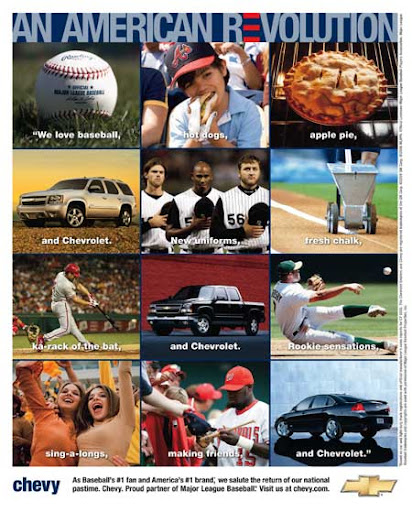
Chevy Brings Back Famous Baseball Commercial

Share
Way to go Chevy!! Nice concept which has generated significant buzz:


Debuts a fresh take on the famed 1970's commercial "Baseball, Hot Dogs,
Apple Pie and Chevrolet"


DETROIT – In 1974, Chevrolet eloquently captured the Zeitgeist with its
classic commercial “ Baseball, Hot Dogs, Apple Pie and Chevrolet.” Now, more
than three decades later, Chevrolet pays homage to the spot originally created
by Campbell-Ewald with a modern spin by ad agency Deutsch Los Angeles.


Launching on July 1, prior to Major League Baseball’s All Star Game and as
part of Chevrolet’s ongoing sponsorship with MLB, t he new spot titled “Love
Affair” ( :60, :30) uses vintage footage from the original commercial and adds
modern elements of baseball including “stolen bases, goat cheese pizza, bottled
water” and “free agents, rally monkeys, fantasy leagues.” The “Love Affair” spot
is part of Chevy’s integrated marketing campaign in support of its MLB efforts.
The campaign includes broadcast, radio, print, on-line, in-stadium, Customer
Relationship Management fulfillment pieces and in-dealership components.


The original song was composed and recorded by famed jingle writer Ed
Labunski in 1974. The Chevrolet commercial also starred Labunski playing the
piano and is widely considered to have changed car commercials and automotive
branding forever. The original spot tied for first place in Car and Driver’s
January 2005 Ten Best Car Commercials.


“The spot marries baseball and Chevy’s nostalgic past with its progressive
present ,” said Ed Peper, General Manager, Chevrolet. “The original commercial
described the connection between Chevy, baseball and American culture so well
that it was the ideal choice to showcase how Chevy and baseball have evolved
over time. While Chevy and baseball have changed, the American love affair with
the two continues.”


World-class photographer/filmmaker Peggy Sirota directed the spot and sought
to capture both the spirit of the original commercial and iconic shots of today.
Her real, yet casual style contributed to a snapshot-quality look, incorporating
new images of skyboxes and mochaccinos, as if they were shot by fans
themselves.


“We saw a real organic, emotional connection between Chevrolet and baseball,
both then and now,” said Eric Hirshberg, Chief Creative Officer/President,
Deutsch LA. “Chevrolet and baseball have changed over the past 30 years, and
have not only kept up with the times, but remained a central part of the
American tradition.”


The comprehensive campaign retains Chevy’s tagline “An American Revolution”
but adds its tagline specific to the effort, “Chevy. Baseball’s #1 Fan.”


The campaign breaks nationally on Saturday, July 1 on Fox and on ESPN on
Sunday July 2. Additional elements will include: program ads, Sports Illustrated
& USA Today inserts, billboards, stadium signage, car toppers, windshield
clings, mirror danglers, wall signs, coasters, buttons, flyers, posters,
interactive efforts on MLB.com, ESPN.com and FOXSports.com, Yahoo Fantasy
Baseball promotion, and an XM Satellite Radio sponsorship, among others.


In 2005, Major League Baseball and General Motors Corporation announced a
three-year sponsorship agreement which made Chevrolet the “Official Vehicle of
Major League Baseball.” The agreement continues through the 2007 Major League
Baseball season and gives Chevrolet exclusive category rights.


Tuesday, May 6, 2008

Excel templates

Share
Ok, so i found this great place for good excel templates...not sure if its like a one sheet fits all types..but worth looking at it

:)

Click here

Sunday, April 27, 2008

GTA IV to boost ps3 sales

Share
Michael Patcher Believes GTA IV Will Boost PS3 SalesAs the GTA IV is just days away, everyone is trying to guess how the new title will shift the numbers in the everlasting battle of gaming consoles.

GTA IV is set to be released for PS3 and Xbox 360 on April 29 and, according to some analysts, the game will be one of the biggest events in the entertainment industry in terms of sales.

Meanwhile, Microsoft and Sony are engaged in a marketing battle, each console maker trying to convince the customers that its platform is better for playing the iconic game.

The game is expected to gain $400 million in sales in its first day of availability. Microsoft’s main argument to lure gamers to buy Xbox 360 and GTA IV is the exclusive content that will be available later this year.

But there are analysts who think that Sony’s PS3 will be the ultimate winner. For example, speaking for Reuters, Michael Pachter, an analyst with Wedbush Morgan, has predicted that the game will directly spur sales of 2 million additional PS3s in 2008, versus 1 million Xbox 360s.

In a comment for Tech News World, Pamela Tufegdzic, an analyst at iSuppli, said that GTA IV definitely will boost PS3 sales and she offered an explanation. The PS 2 owners will be probably eager to upgrade their consoles in order to play the new title.

In fact, GTA is one of the titles that helped Sony sell its PlayStation 2.

Putting aside the gaming consoles battle, there is one sure winner: the retailers. Some of them are already planning to extend to programs of their stores to match the buying gaming madness that will start on Tuesday.

Web 2.0 Expo Reveals: Mobile Is The New Desktop, Social Nets The New Media Companies

Share
Remember, you read it here first. Wolfe's three laws of the brave new Web 2.0 world are: Mobile is the new desktop, the home page is dead, and social networks like Facebook and MySpace presage the media company of the future. These catchy Web 2.0 catch-phrases popped into my head during a heavy week of session-sitting at the Web 2.0 Expo in San Francisco. Here's why I'm optimistic that those of us who are ready to embrace the virtual future are going to be in for a fun ride.

These aphorisms are part of my attempt to make sense of the rapidly shifting playing field, in which those of us who've spent the last several years ramping up our blogging efforts -- and patting ourselves on the virtual back for being in the forefront of the new-media revolution -- find all of a sudden that we're no longer quite so cutting edge.

Nope, that title would go to the folks who've put together the powerhouses that are the online social networks. I'm talking about sites such as Facebook, MySpace, Orkut, and Hi5 (the latter is the Spanish-speaking world's popular destination.) Hence my first new-age Web law:

Social networks are the new media companies.

Only a few months ago, I was mightily perplexed by the popularity of sites like Facebook and MySpace. However, I figured that, after people grew tired of farting around with pictures or movie quizzes (or, for MySpace users, when they reached puberty), they'd move on to "real" sites. You know, sites like this one.

Savvily, the people at Facebook, MySpace et al, appear to have thought of this, too. And they've got a solution. They've opened up their social networks to developers, who can build their own apps and post them so users can put them on their own FB and MS pages. There's even an open API for developers, called OpenSocial, which most of the social nets are supporting, to a greater or lesser extent.

There's another wrinkle, which is that developers can put their own ads inside the social-net apps they build. This is a method of monetizing one's social-app, akin to whatGoogle (NSDQ: GOOG) allows when you drive traffic from your Web site to its Ad-Sense advertisements.

So now kids in Kansas or moms on the Upper West Side of Manhattan have the tools (OpenSocial) and the incentive (ads) to build FB and MS apps. Scarily, for the Time-Warners of the world, there's nothing to keep these table-top developers for building apps which are more popular and attract more users those from the big guys.

Indeed, in one important way, the pimply faced developer hordes have an advantage over the legacy media types. Namely, they're not encumbered by corporate planning cycles. Or, as those Royal Bank of Scotland ads put it, pace Steve Jobs, "just do it."

This doesn't mean that traditional media companies, which have spent the last five years transitioning pell-mell from print to online, are necessarily screwed. But it does mean that they get no Brownie points for the work they've done thus far. All they get is a swift kick in the social-networking pants and -- if they're smart -- notice that they've got to rush to embrace yet again another new model. That would be one that's built around very lean and rapid software development.

This brings us to Wolfe's second new rule, which is :

The Home Page Is Dead.

(OK, I'm a bit ahead of the curve here, but this is beginning to happen already.) Think people will always come to wearetheauthoritativedestination.com just because they've always come there? Hey, the people who publish the print edition of The New York Times think that, too.

No one, and I can't stress this enough, gives a shit about your brand. They care about what user experience you deliver to them. This obtains whether you're in the physical world selling a product, or online serving up content.

Take Ford as a prime example. The company was dying, not only because it was building the wrong mix of products, but because no one wanted its cars. New CEO Alan Mulally is turning things around, largely because he's refreshed the product line with attractive looking autos.

Then there's one of my favorites, RIM (NSDQ: RIMM), which makes the Blackberry. Here's a product which is wildly successful, in spite of its anti-sexiness. Why? Because it deliver the apps users want to use, how they want to use it (great e-mail, reliably.)

I know, you're gonna counter that Apple has this whole idea of branding locked down. Maybe more than most, but come back after the Google Android phone is released, especially if Apple's iPhone doesn't keep pace.

My closing thought on the traditional home page being dead is a quick word about what's going to replace it. The new go-to destination of users won't be home pages but instead will be Web apps. That is, users will access content -- news, blogs, video -- and interact with your (their) communities via apps, hopefully apps that you develop and sell ads around.

So what are you waiting for? Get going; start developing your apps now. And don't be a planning deer caught in the Web 2.0 headlights, either. Develop lots of apps, quickly. Post them up and don’t obsess over them. Your users will tell you which ones they like; those should be the ones you invest in and develop further. (What do you do with this others? Simple. Throw them away.)

This brings me to my final thought, which is where we came in:

Mobile Is The New Desktop.

All this talk about the rise of social networks, the impending death of Web sites envisioned as traditional home-page destinations, and the need for lithe, rapid development points towards one final thought, which is perhaps bigger than all the others put together.

Namely, mobile is (more correctly, will be, but very soon) the new desktop. For all its flaws (most, in the scheme of things, relatively minor) Apple's iPhone, like the iPod before it, presages a new model of user interaction with technology.

One pundit at Web 2.0, Brian Fling, put it more succinctly. He sees the iPhone as a new medium in and of itself, as significant as radio, television, and the Internet itself have been. Moving forward, the iPhone itself won't be important per se because many phones will be iPhone-like. But Steve Jobs has paved a path which others, including /Android andNokia (NYSE: NOK), are beginning to follow.

Why is the phone-plus-browser-plus-email such a big Web 2.0 deal? The game-changer is not so much its functionality as the simple fact that it's. . . always on. All of us who've been repelled by our compulsion to send work e-mails at midnight understands this phenomenon. When you think about it, the Smartphone is the first device that fulfills McLuhan's prediction that electronics will become an extension of the human nervous system. We're getting there, although it's hard to see, since we don't have the benefit of hindsight.

Me, I'm not nervous about it, which isn't to say I don't have concerns. Mostly, I intend to participate in the mobile-apps revolution. Somebody's gotta do some stuff for us adults, right?